
-
Should I Replace My Shocks and Struts?
Why Your Suspension Matters
Every car and truck is suspended by a combination of springs, shocks, and struts. These parts, known as your suspension, add to the safety, performance, and longevity of your car or truck as they move up and down up to 1,900 times every mile. By the time you put 50,000 miles on your vehicle, those parts will have done their job 75-million times, working in tandem with your brakes, steering, suspension, tires (helping ensure your tread wears evenly), and all of the modern crash-avoidance systems found in new vehicles.
Les Schwab Quick Fact: Shocks and struts do not typically support your vehicle’s weight or any loads your truck might be carrying. The springs do that job. Worn out shocks and struts put more strain on the springs.
While parts of your suspension will wear out over time, it can be difficult to notice problems during your daily commute. Here’s how to spot problems with your suspension.
Test Your Shocks and Struts
The next time you’re out for a drive, pay attention to your vehicle’s handling as you answer the following questions.
Other Signs of Suspension Issues
If you answer yes to any of the above, it could be time to get into your local Les Schwab. We’ll check your shocks and struts for free. See our Shock and Strut Service and Repair FAQ for more.
Schedule an Appointment -
What Do Dashboard Brake Lights (Brake Warning Lights) Mean
There are quite a few dashboard lights in most of today’s vehicles. These are designed to get your attention when things go wrong. Those include your tire pressure light, check engine light, and issues with your brakes. When a dashboard brake warning light appears, it’s important to know what it means and how Les Schwab can help diagnose brake issues, fix most brake problems, and get you safely back on the road. Here’s what dashboard brake lights mean and what to do when you see one.
Common Dashboard Brake Lights & What They Mean
When you first start your car, every dashboard light you have will light up for a brief moment. Then, they’ll go out, unless there is an issue. If one of the brake warning lights stays lit, or appears as you drive, the following images will help you identify it and decide how soon to get into Les Schwab for your safety.
Anti-lock Braking System Light
This is your car’s ABS (anti-lock braking system) light. The ABS system reduces skidding and stopping distance in emergencies. When you see either of these indicators, your car’s ABS may have an electrical problem. Go straight to Les Schwab. Don’t ignore it, even if you haven’t noticed any change in your car’s braking or handling.

Brake Service Light
These dashboard lights could indicate that your brakes need servicing or that your parking brake has been left on. If the light goes off when you disengage the parking brake, you’re all set. If not, get to Les Schwab so we can check your brakes for any other safety issues.
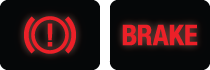
Parking Brake Light
Some vehicles have a PARK light, while others have a BRAKE or ((P)) indicator that illuminates when your parking brake is engaged. If your parking brake isn’t engaged, or any of these lights remain on when you disengaged it, there may be an issue. These can include hydraulic brake components or low brake fluid in the master cylinder. Unsure about these parts or fluids? If these lights appear and stay on, stop by Les Schwab and we’ll take a look.

When Did the Brake Light Turn On
Brake warning lights should not be ignored. You need those brakes to stop safely, whether you’re driving across town or cruising on the highway. If any one of your brake warning lights stays on after you start your vehicle, or if they light up while you’re driving, see the above images to help pinpoint what that brake light means and when you should get to Les Schwab for a full inspection.
Main Reasons Why A Brake Light is On
Dashboard brake lights that turn on after starting your vehicle or while driving can be caused by a few scenarios. These include:
The parking or emergency brake is engaged.
If your parking brake (commonly known as an emergency or hand brake) is pulled or engaged, it can cause a dashboard emergency light to illuminate. Even if yours is not pulled or activated, try to turn it on and off (engage and disengage). If the dashboard light turns off, there are likely no issues with your brakes.
There’s an ABS issue.
If the Anti-lock Braking System (ABS) light appears, there may be something wrong with your ABS system. This can pose a safety risk for you and your family. Get to Les Schwab where our technicians can diagnose and possibly repair the issue.
Brake fluid is low.
There is a sensor inside the brake master cylinder that continually monitors your brake fluid levels. When levels get too low, the warning light will appear. This indicates that you need additional brake fluid added to your vehicle. If left unresolved, the lack of brake fluid can cause brake failure and other damage.
A brake light has burned out.
Not all vehicles have this dashboard light, but if yours does you’ll get an alert when one or both of your brake lights (on the back of your vehicle) are no longer working. Don’t wait to get your brake lights replaced. These lights warn other drivers that you are braking, keeping you and others safe on the road.
Brake pads wearing out.
In most cases, you’ll know your brake pads are getting low, and will soon need servicing, when you hear the brake pad wear indicator. The indicator emits a constant, high-pitched screech that comes from the wheel. The sound only goes away as you use the brake pedal. Learn more about this high-pitch sound along with other brake sounds and smells. Please note: in some vehicles, an indicator light will appear as your brake pads wear down and need servicing.
How to Turn Off Brake Lights on the Dash
Your vehicle’s dashboard brake light indicators are there for your safety. When one appears, determine what the warning light is trying to tell you and then diagnose the issue. If it’s simply your parking brake, the light will likely disappear when you engage and disengage it a few times.
To ensure that the light is not simply on because of a stuck pedal or other small issue, turn your vehicle completely off and then on again. If the dashboard indicator is still there, get to Les Schwab. Our technicians have been specially trained to inspect and repair your brakes.
Visit a Nearby Les Schwab for a Free Brake Inspection
When a brake light appears on your dashboard, get to your local Les Schwab. Our brake pros will perform a free brake inspection. If nothing needs to be done, they’ll let you know and send you on your way. But, if you do need brake servicing, they’ll put together a detailed cost estimate, explain what needs to be done to improve your safety, and answer all of your questions.
Find Your Store -
What Causes Brake Lock-Up
The brakes on your vehicle are certainly one of its most important safety features. So, when they apply on their own or lock up when you need them most, it can be both dangerous and nerve-wracking. Here’s why it can happen and what to do if it happens to you.
When Brake Lock-Up Can Happen
While diagnosing a brake issue is important, nothing else matters in the moment when you’re dealing with a lock-up. When your brakes lock up, it often boils down to two scenarios: locking up when you least expect it (and have not applied pressure to the brake pedal), or when you hit the brakes hard.
Brake Drag or Self-Applying Brakes
Even though you may not have pressed on the brakes, residual hydraulic pressure can cause the brake calipers to activate and lock. This is the most common form of lock-up. Don’t ignore this problem as it can quickly lead to mechanical failure of other parts of your braking system.
Brakes Lock-Up When You Hit the Pedal
This can happen when you are both braking hard to avoid an accident, or braking gently to glide to a stop. Essentially, the force of applying the brakes (even lightly) can activate the full stopping power of your brakes – bringing you to an abrupt and less-than-safe stop. You might even skid. When this happens, you could lose control of your vehicle.
See our Complete Guide to Disc Brakes and Drum Brakes as well as our Brake Service FAQ.
Common Reasons Brake Lock Up
There is a long list of reasons for brake lock up. These can include:
- Overheated braking system
- Using the wrong brake fluid
- Damaged or broken parts (calipers, brake pads, pistons, rotors, or others)
- Defective ABS components
- Broken parking brake
How To React When Brakes Lock Up
When you’re on the road and your brakes lock up, quick action could help you avoid an accident and keep your family safe.
- Apply pressure to the brakes and try to gain as much control as possible. If your vehicle has an Anti-lock Braking System (ABS), you’ll feel some feedback in the pedal and could hear a mechanical-type noise as your vehicle comes to a stop. The feedback is the ABS working to keep the wheels from locking up and preventing you from skidding.
- Take your foot off the brake pedal. That way your wheels can get enough traction to possibly unlock momentarily. Then reapply pressure to the brake if needed.
- Repeatedly (and quickly) press the brakes over and over. You’ll likely do this naturally. Hitting the brakes again and again could disengage the brakes and/or bring you to a safe stop.
Whether you’re experiencing brake drag or brake lock-up, get to your local Les Schwab as soon as safely possible. Our technicians will ask what wheel or wheels seem to be locking up and when. Any information you can provide will help with the diagnosis and repair.
What To Do After Experiencing Brake Issues
The tires, wheels, shocks, struts, steering, and alignment all work in tandem to make driving safer and more enjoyable, but it’s the brakes that allow you to stop your vehicle and stay in control. While the cause of the lock-up could be simple, there could be other mechanical issues with your car or truck. Those issues could put you and your family at risk, not to mention others on the road.
If you experience brake lockup, get to Les Schwab. If it’s safe to drive the vehicle, do so carefully. Otherwise, call a tow truck and have it delivered to one of our stores. We’ll perform a free visual inspection and share what we find. If your brakes need a more detailed diagnosis, we’ll chat with you about what needs to be done and any charges that may apply before starting any additional work.
Free Brake Inspections at Your Local Les Schwab
When you experience braking problems, or just want to have your brakes professionally checked or repaired, get to your local Les Schwab. Our technicians have been specially trained in both disc and drum brakes, as well as how all the interconnected components work together for your safety.
During your Les Schwab brake inspection, we’ll look for brake pad wear, check hoses for cracks, and complete a full visual analysis.
After your Les Schwab brake inspection, you’ll get a full report outlining the current condition of your brakes. If your brakes need any work, our service pros will make recommendations and show you all the costs and warranties.
Find Your Store
Opens warranty information dialog with language options