
-
Wheel Alignment FAQ
What Is a Wheel Alignment?
Though it’s sometimes subtle, the alignment of your wheels can get out of whack from everyday driving. This reduces your vehicle’s drivability, lowers gas mileage and causes early tire wear. An alignment is the process of adjusting the angles of your vehicle’s wheels back within original specifications to improve their contact with the road.
Are Wheel Alignments Necessary?
An alignment improves vehicle safety by keeping the right amount of the tire in contact with the road and preventing your vehicle from pulling to the left or right. A properly aligned vehicle has a smoother ride and optimal gas mileage. Keeping the wheels aligned also extends tire life.
What Affects Wheel Alignment?
Over time, normal settling of the suspension, including fatigue of springs and bushings (rubber cushions that dampen the amount of movement and noise), will gradually change alignment. Hitting a pothole, going over big bumps, rubbing up against a curb or rolling over debris can also push wheels out of alignment. Additionally, aggressive driving, carrying heavy loads, bent or worn suspension/steering parts, or a slight fender-bender can trigger misalignment. To improve your vehicle safety, get your vehicle aligned twice a year or when you buy new tires. Other times to get your alignment checked include:
-
After a sharp impact with a curb or pothole
-
If you go offroading a lot
-
When tires are wearing unevenly
-
Anytime you lower or lift your vehicle
-
When steering or suspension parts that affect the tire angles are replaced
-
If you notice your vehicle drifts or pulls to one side
-
If the steering wheel is off-center when you’re pointing straight
-
After an accident
How Can I Tell If My Vehicle is Misaligned?
Even if your vehicle is out of alignment, you might not notice it over time. Indications of a misaligned vehicle include:
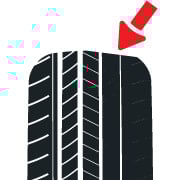
Uneven
Tire Wear
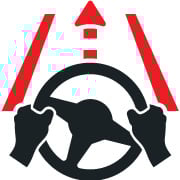
Steering Wheel
Off-Center
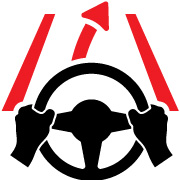
Pulling or Drifting
When Steering
Can Misalignment Cause Steering Wheel Vibration?
Not likely. Vibrations in the steering wheel, the floorboard or the seat (especially at highway or freeway speeds) is likely a sign that one or more of your tire/wheel assemblies is out-of-balance, or you are experiencing another tire issue.
Can Misalignment Cause Noise?
No. Generally, any noise from misalignment is caused by abnormal tire wear. If tires are the source of road noise, an alignment correction may be needed. However, this won’t solve the noise problem.
Will Misalignment Affect My Tires?
Yes. If they show moderate-to-severe edge wear or feathered wear, it likely means they’re out of alignment. This is often an indicator that the toe or the camber angle is off.
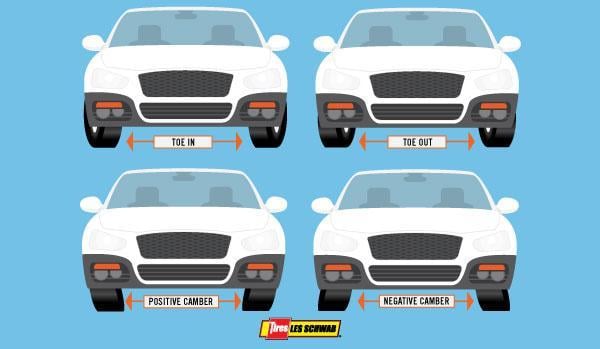
Camber Affects Wear and Cornering: The inward and outward tilt of the tire and wheel assembly (viewed from the front of the vehicle) is called camber. When the top of the tire is leaning inward, it is a negative camber. Positive camber has the top of the tire tilting outward. Each manufacturer sets a specific camber alignment for every vehicle it produces, which might be either positive, negative or zero (0º). When the camber is at the correct angle, the tire and wheel will roll straight.
Generally, camber plays a key-role in cornering performance. If the camber is out of the manufacturer’s range, it can cause handling issues and excessive tire wear, which costs you money. If a vehicle has rear-camber adjustments, adjusting the rear camber plays a big role in straight-line stability and cornering.
Toe Is the Most Important Angle for Tire Life: Of all the angles, the toe can fall out of alignment the easiest. A toe that is properly calibrated to manufacturer specifications (which can be either slightly positive or negative) will be at zero (0º) when on the road. This means all of the tire and wheel assemblies (front and rear) are pointing in the same direction. When the toe is at the correct angle, there’s less friction on the tires as they roll. When they are facing away from each other (toe-out) or toward each other (toe-in), they’re essentially scrubbing on the road ever so slightly with every passing mile. This can reduce tire life.
How Are Wheel Alignments Done?
A wheel alignment is done using an alignment machine that measures your wheel angles. These are calculated and compared against your vehicle’s original specifications.
-
The technician makes adjustments to the camber, caster, and toe of each wheel as needed.
-
A real-time computer readout shows when the target angles are met.
-
Your steering wheel is checked to ensure it is centered.
-
Finally, your vehicle is given a quick test drive.
What Are the Types of Alignment?
Your technician will advise what kind of alignment is best for your vehicle type. Generally, a four-wheel alignment will cost more than a standard or thrust alignment.
Thrust Alignment: A thrust alignment is the most accurate alignment for vehicles without adjustable rear suspension. Only the front wheels are adjusted. Here’s how: There’s no guarantee both rear wheels are pointed straight ahead as they should be. One may be pointed exactly forward and the other slightly off. Or both their angles could be off. Since this can’t be adjusted, the front wheels are aligned as closely as possible to the thrust line, which is the average of where the two rear wheels point. This compensates enough to get a centered steering wheel.
Four-Wheel Alignment: This is done on vehicles with adjustable rear suspension, to bring all four wheels of your vehicle back into your vehicle’s original specifications. All four wheels are aligned to the center of the vehicle. First, the rear axle angles are measured and adjusted, then the front. This is the best, most accurate, manufacturer-recommended alignment for vehicles with adjustable rear suspension.
Should I Get an Alignment When I Get New Tires?
Yes. Getting an alignment when you replace tires is one of the best ways to get the most mileage out of them. Be sure to ask for an alignment, since it’s not generally part of the tire purchase price.
How Often Is Wheel Alignment Needed?
Regular alignments are part of basic auto maintenance. Catching misalignment early means you can correct your wheel’s positions before you have premature tire wear. Cars usually go out of alignment gradually, so it’s important to check it at least annually, or twice a year if you travel roads that are washboard, rutted or full of potholes.
What Other Times Should Alignment Be Checked?
-
After a sharp impact with a curb or pothole
-
If you go offroading a lot
-
When tires are wearing unevenly
-
Anytime you lower or lift your vehicle
-
When steering or suspension parts that affect the tire angles are replaced
-
If you notice your vehicle drifts or pulls to one side
-
If the steering wheel is off-center when you’re pointing straight
-
After an accident
Les Schwab does free visual alignment inspections. If we recommend an alignment but find during the course of the work that your alignment is good and can’t be improved, there’s no charge.)
Is Four-Wheel Alignment Only for 4-Wheel-Drive Vehicles?
Regardless of whether they’re 4WD, front-wheel-drive or rear-wheel-drive, most cars and many SUVs today are four-wheel alignable. These vehicles should get a four-wheel alignment because the rear is just as likely to be out of alignment and cause uneven tire wear as the front.
Does Misalignment Affect Gas Mileage?
Yes. When your wheels are properly aligned, there’s less rolling resistance. Tires with less rolling resistance experience less friction which may improve fuel efficiency. If the situation continues, the tires will wear unevenly and lead to worse gas mileage.
Is Alignment the Same As Balancing?
No. Alignment and balancing are two very different repairs. Rebalancing tires is a process of attaching small weights, just fractions of ounces, to the wheel. This ensures the weight of the wheel is even around the entire unit. Although they’re round, tires have manufacturing imperfections and wear that create lighter and heavier areas. The weights compensate for this.
Rebalancing is done in a tire shop by putting the wheel-tire unit on a tire-balancing machine that detects imbalance in the tire/wheel assembly. This shows where the imbalance is and the amount of weight needed to counter that imbalance. It’s most often done when new tires are installed. Les Schwab performs tire balancing with every rotation. However, it is not part of an alignment.
What’s Included With an Alignment?
Les Schwab wheel alignments include a tire inspection, test drive before, steering and suspension inspection, tire pressure check and adjustment, alignment angles measured and adjusted, test drive after, and a printed report showing before and after measurements. Alignments done at Les Schwab Tires are covered by a 30-day guarantee, which includes labor.
Will an Alignment Fix a Crooked Steering Wheel? Loose Steering?
An off-center steering wheel is one sign of misalignment. A wheel alignment may restore the steering wheel to a centered position if there aren’t other undiagnosed problems.
When alignment angles are out of the vehicle’s original specifications, steering can feel slightly loose. This condition can be corrected by a wheel alignment. But if you’re noticing a lot more steering wheel movement than normal, there may be worn steering or suspension parts. In this case, the loose parts should be identified in the pre-alignment inspection and repairs should be recommended before aligning.
Are Wheel Alignments Covered Under Warranty?
Check your vehicle’s owner manual for the original warranty.
How Much Does a Wheel Alignment Cost?
It varies according to vehicle type, shop, region and type of alignment. A quality shop will advise in advance what type is best and what it will cost before performing the work. A great shop only charges for work that is actually needed once the job is underway.
Where Can I Get a Wheel Alignment Done?
Les Schwab Tires offers full wheel alignment services — including adjustments and free inspections — usually without an appointment.
How Long Does a Wheel Alignment Take?
A wheel alignment service, once your vehicle is in our service bay, can take up to one hour. The time frame depends on the severity of the misalignment and whether or not your vehicle requires a thrust, or four-wheel alignment. The pros at your local Les Schwab Tires can give you an accurate time estimate.
Find A Store -
-
It’s Not Just Hype! Lift and Leveling Kits Add Height and Heft.
The vehicle you drive says a lot about who you are. If you’re happy with the way the front end on your F-250 sits 2-inches lower than the back, or you’re content owning a standard Crosstrek or Jeep, you’re all set. But for those who want a more customized, personal look and some added ground clearance for off-road and overlanding excellence, lift and leveling kits are the way to go. Especially with Les Schwab standing behind every lift and leveling kit we install with a full parts-and-labor warranty.
What’s the Difference Between Lift and Leveling Kits?
Lift kits increase the height of both the front and back of a vehicle, giving your crossover, SUV or truck a more customized look. Most options allow you to raise a vehicle anywhere from 2 to 4-inches. With certain vehicles, there are options that offer up to 6 to 8-inches of lift.
A leveling kit is designed to raise the front of a truck so that it’s level with the back, eliminating the nose-down look (also known as the factory rake). Many new trucks are designed with a rake to ensure they are level when hauling heavy loads.
Leveling Kits vs. Lift Kits
Depending on what you want to accomplish, a leveling kit allows you to eliminate the nose-down look of most trucks and allows for a larger wheel and tire, while a lift kit gives your vehicle more clearance, a heftier look, and the option to install even larger wheels and tires.
What Should You Choose?
That depends on what you drive, what look you’re going for, and how much lift you want. Some of the more common options include:
Truck and SUV Leveling Kits
If you’re driving a full- or mid-size truck or SUV, a leveling kit can add a nice, rugged stance to your vehicle. This option is quick, easy, and affordable. Just tell us what you want, and we’ll show you all the options.
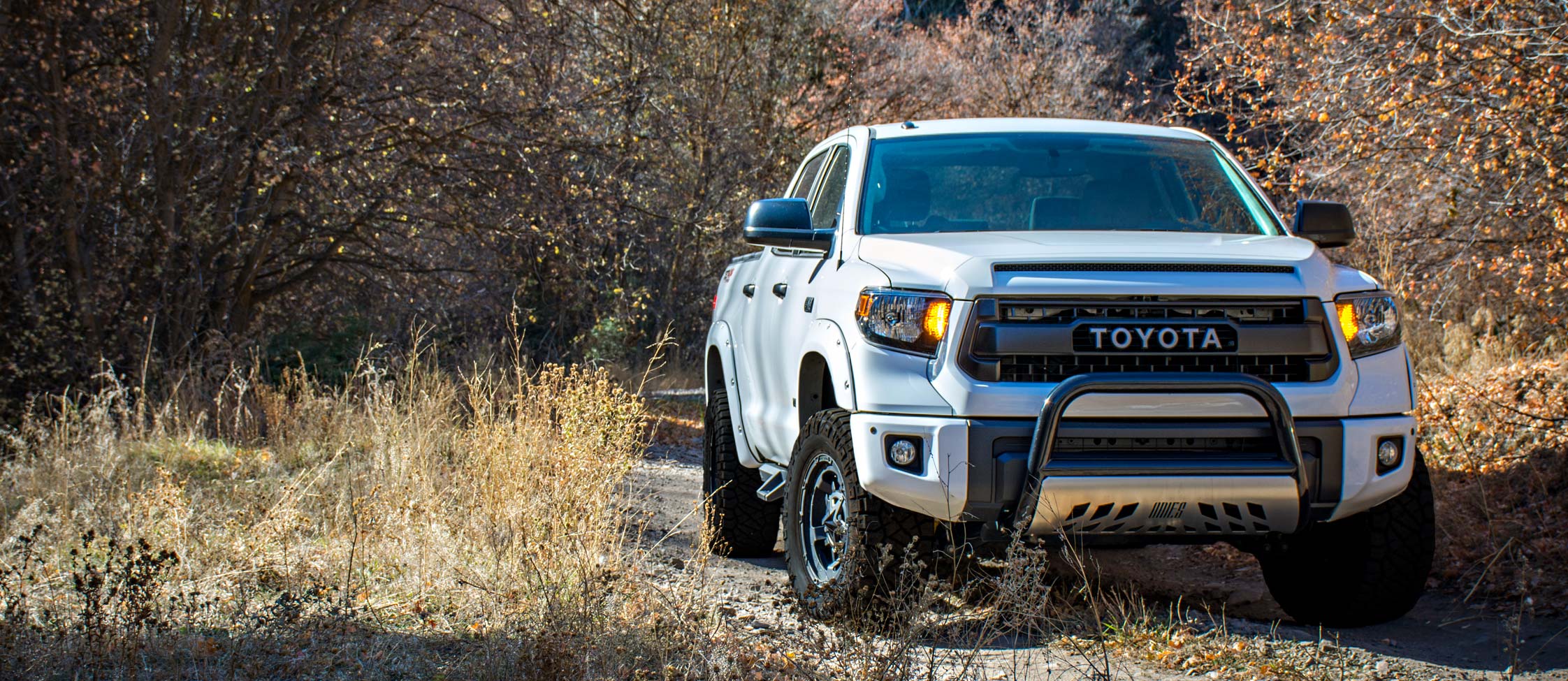
Image courtesy of Tuff Country
Overlanding Lift Kits
It’s all about the journey, right? It’s also about how you look during your daily commute (even if you’re not driving a truck). Adding just a little more height to your offroad crossover or SUV will give it an extra bold stance and added clearance to venture further into the wilderness. Stop by your local Les Schwab and we’ll show you all of your customization options, order everything you need if it’s not already in stock at the store, and get it installed.
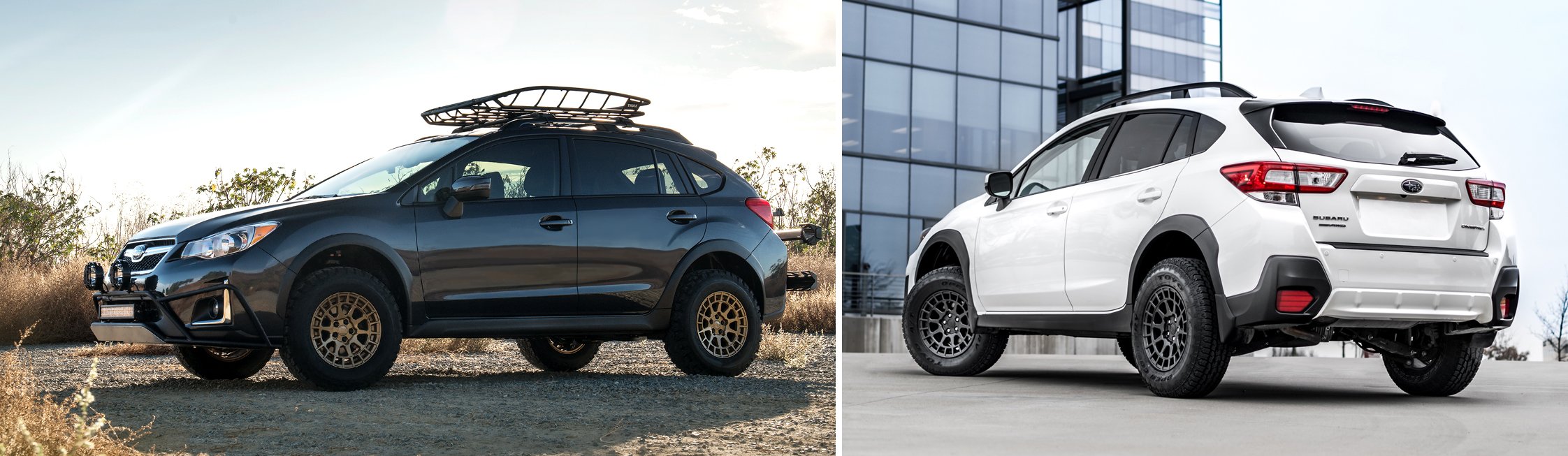
Images courtesy of TSW
Full-Size Lift Kits
When you’re ready to take the plunge and dominate the road as well as your worksite, nothing says rugged and hard-working like a truck that’s been lifted 4- to 8-inches depending on the application. Once you get that done, you’ll have the option of choosing bigger tires and wider wheels to showcase your ride.
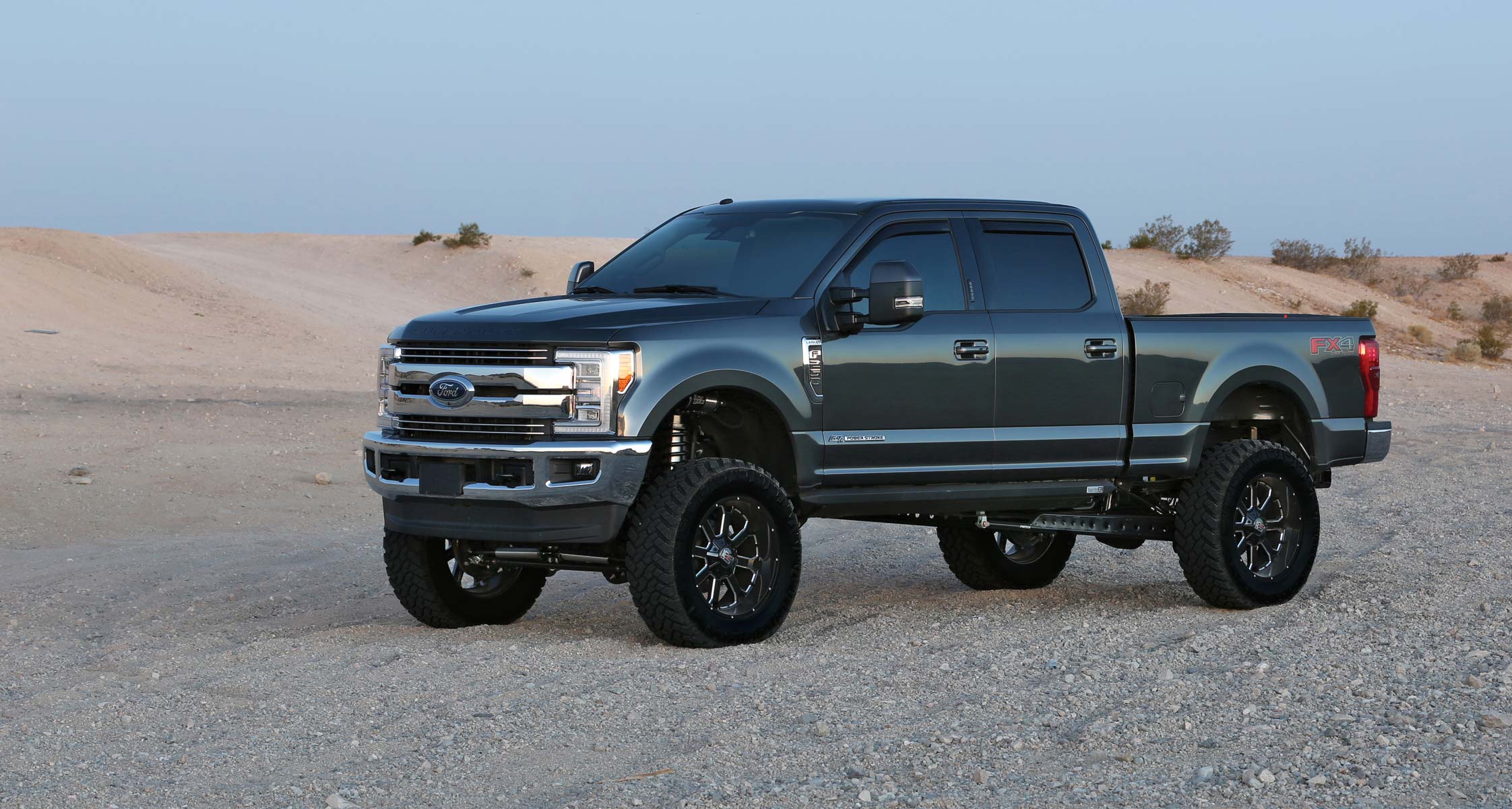
Image courtesy of Fabtech Motorsports
Les Schwab Takes Care of All the Details
When we install a lift or leveling kit on your vehicle, we’ll double-check the suspension, brakes, shocks, steering, and alignment. We’ll also perform a retorque and recheck your alignment a few miles down the road, just to ensure everything is perfect.
Get Your Lift and Level Done Right
Giving your vehicle more clearance and a better stance is an easy update when you know what you’re doing. The pros at Les Schwab have been lifting and leveling trucks, crossovers, and SUVs for years. Stop by and tell us what you want to do to your vehicle and we’ll show you how to get it done.
Schedule an Appointment -
How to Jump-Start a Car
Starting your car is a rather easy process, unless the battery has completely failed. Then, you’re not going anywhere. Luckily, jump-starting your vehicle is also easy. All you need are the right tools and know-how to get it done right. Here’s what you need to know.
Common Reasons for a Battery Dying
We’ve all left the lights on in a car or truck only to find a dead battery a few hours later. Thankfully, that doesn’t necessarily mean the battery has failed or reached the end of its life. It may be possible to jump-start it and enjoy years of uninterrupted use. To get the most out of your battery, try to avoid a few battery-killing scenarios.
Deep Discharging: leaving the lights on or the stereo going while the car is turned off. This can result in a dead battery or a clicking noise when you try to start the vehicle.
Hot Summer Days: Hot, summer months can deteriorate your battery over time. You simply notice it in the winter when it takes more power to crank over a cold engine — power the deteriorating battery doesn’t have. If you can, store your vehicle in a garage or under a shelter on the hottest days.
Corroded Connections or Cables: Check your battery cables often for corrosion. If you find any, clean it off to ensure a tight connection.
Les Schwab Tip: The professionals at your local Les Schwab can check your battery for free – even if it isn’t dead. We may be able to recharge it at no cost if it’s still in good condition.
Must-haves for Jumping a Car Battery
Jumper Cables or a Jump Starter: Jumper cables come in various lengths. The ends of the cables include red and black alligator clips made of copper. To jump-start a car, these clamps attach to the leads of the dead battery and to the vehicle that will help jump-start the dead car or truck. See below for proper procedures. Jump starters come with a smartphone-sized 12-volt battery and a set of red and black cables and clips. These attach to the battery of the dead vehicle and quickly jump-start it with a burst of power.
Gloves: A simple pair of rubber gloves can help protect your hands from corrosive battery acid and other harsh chemicals. Keep a pair with your jumper cables or jump starter.
A Vehicle With a Working Battery (If Using Jumper Cables): To successfully jump-start a vehicle, you’ll need another car or truck with a working battery.
Jumpstarting Your Car: What Are the Steps?
When you have the right tools and know-how from the pros at Les Schwab, jumpstarting your car is easy.
Line up the front of your vehicles and open both hoods.
Take the key out of the ignition in the car with the dead battery. The other vehicle should not be running.
Untangle your jumper cables.
On the dead battery, hook up the red or positive clamp to the positive post on the battery.
Hook the red clamp on the other end of the jumper cables to the positive post on the good battery.
Important: Be sure the black clamps do not touch the red clamps.
Attach the negative or black cable to the good battery. Then connect the other end of the black cable to the negative post on the dead battery. You can also attach it to a piece of solid metal in the engine compartment.
Important: Keep your jumper cables away from engine fans or hot engine components.
Start the vehicle with the working battery and let it run for a few minutes.
Now, try starting the vehicle with the dead battery. If it starts, let it run for a few minutes. If not, allow the car to charge for another minute before another attempt.
To remove the cables, start with the black cable on the previously dead car, then remove the black clamp off the starter car. Finally remove the red from the newly jumped vehicle, and then from the other car or truck.
Les Schwab Tip: Once a car is successfully jumped, you’ll want to go for a short, 30-minute drive. This will give the alternator a chance to recharge your battery, if the alternator and/or battery are in proper working order. If it does not hold a charge, bring it in to Les Schwab for a quick check.
How to Prevent Your Battery From Draining?
The life of your car battery depends on where you live, how much you drive, and how often you start your vehicle. But you can also help prevent it from draining with a few tips.
Unplug Extra Accessories: Known as parasitic draw, your car battery can drain over time from stereo components (such as subwoofers), and phone chargers that continue to work when the car is turned off. Also, be on the lookout for glove-box lights, trunk lights, and interior lights that remain illuminated when the vehicle is off.
Take a 15 Minute Drive: At least once per week, take your car for a short drive. As long as your alternator is working correctly, this will continually recharge your battery.
Don’t Leave Your Headlights On: Turn the switch to the “off” position, even if your lights go off automatically.
Tighten and Clean Battery Connections: If your battery terminals are loose or corroded, it can cause your car to stall. It could also damage the battery.
Les Schwab Gets a Charge Out of Checking Your Battery
With today’s modern vehicles, it can be difficult to tell if your car battery is going dead until it’s too late. Come by your local Les Schwab Tires for a free inspection of your car battery. We carry new batteries for most vehicles, and offer recommendations to keep you from getting stranded.
Shop for Batteries
Opens warranty information dialog with language options